
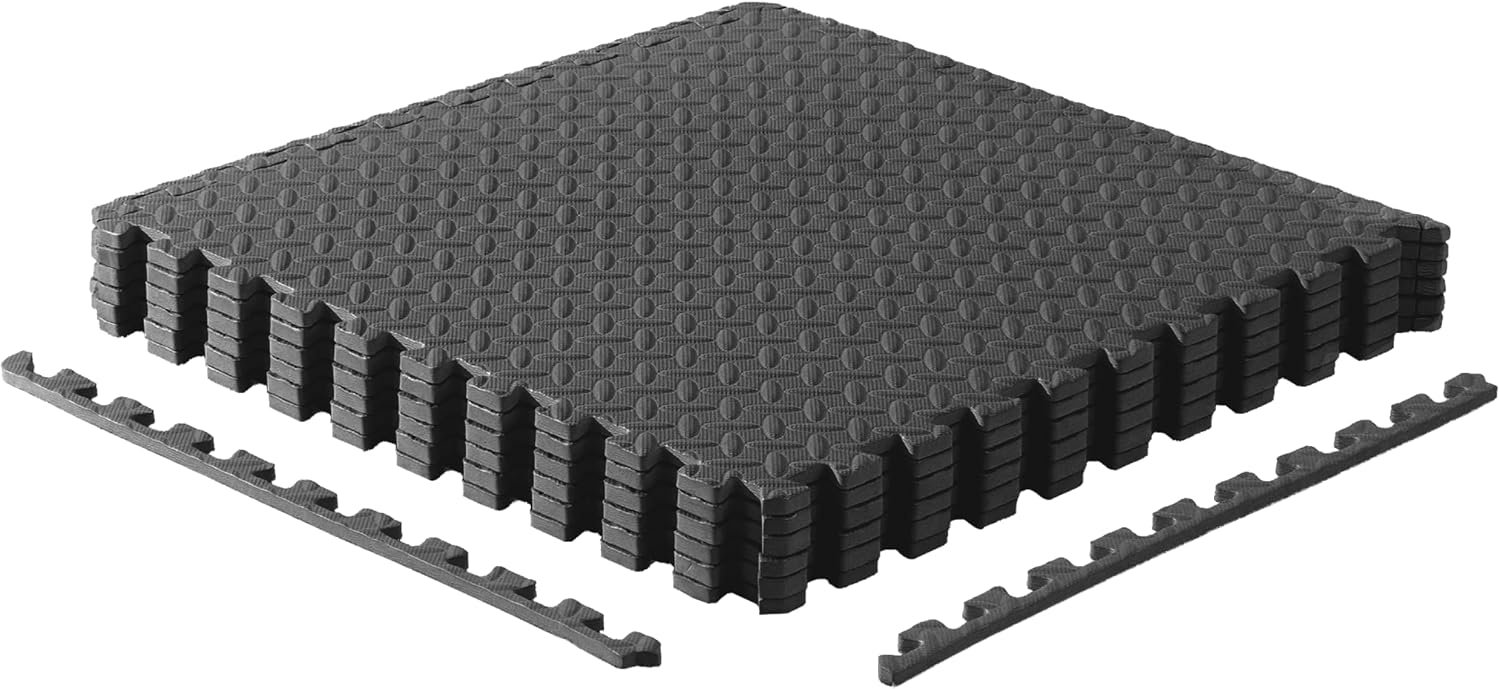
A sourcing pattern I keep running into after years of buying interlocking puzzle mats: a surprising number of brands paying for “EVA” puzzle mats have no idea that much of what they receive is PE — and PE costs roughly a third less. Neither the buyer nor the end customer feels the difference on day one.
This matters whether you are sourcing kids play mats, gym and fitness floor tiles, or general interlocking foam tiles. When purchasing puzzle floor mats, most buyers focus on size, thickness, color, packaging, and price. The question almost nobody asks is the one that quietly protects your margin and your review score:
Are the puzzle mats I am paying to be EVA actually EVA?
The problem is not the material. The problem is paying the wrong price for a material you never verified.
Why Does This Material Confusion Happen?
EVA and PE foam can look almost identical once they are die-cut into puzzle tiles and surface-textured. A finished mat does not show:
- Raw material ratio
- Foam structure
- Production formula
- Internal material composition
This is not a “hard to spot by appearance” problem in theory — it is a practical reality. Across years of orders, buyers, purchasing agents, and end consumers have routinely handled these mats without ever noticing the material identity had changed. The name on the invoice is not something the product itself confirms.
Experienced buyers learn that the material name alone is never enough.
Why Would a Supplier Use PE Instead of EVA?
The reason is cost. Depending on specification, PE can come in roughly a third below a comparable EVA solution. On large-volume puzzle mat orders, even that gap moves supplier quotations, product margins, retail pricing, and brand competitiveness.
The important question is not “Is PE bad?”
The real question is:
Are you receiving the material you are paying for?
Two Kinds of Buyers, Two Different Bills
Once you see the pattern clearly, brands buying “EVA” puzzle mats fall into two groups — and the cost each one pays is very different.
The genuinely unaware buyer. They believe they bought EVA, the quote looked attractive, and they never questioned it. The product is fine — it does not fall apart, and that is exactly why the problem stays invisible. The bill is simply deferred, and it is not a durability bill: they are paying an EVA price for a material that costs roughly a third less, so the margin leak is already on the books, just never counted. It surfaces the moment they have to reconcile what they claimed against what they actually shipped — a PE tile sold under an EVA name is a claims and labeling exposure no matter how long the mat lasts. This buyer sleeps well only because nobody has opened that ledger yet.
The buyer who knows and says nothing. They receive PE, sell it under an EVA name and price, and pocket the difference. This trade exists in low-price markets. The cost is structural, not delayed: short-term margin is borrowed against brand trust — once consumers notice or a competitor calls it out, returns spike and repeat purchases collapse. In Western markets it also crosses a compliance line, because inaccurate material labeling is a real exposure on marketplaces and in retail audits, not just a scoring issue.
The practical takeaway: a “too cheap to be true” EVA quote usually is. The only question is whether you are the one being fooled, or the one quietly fooling your own customer. Both cost you money — one just bills you later.
A sourcing middle who profits from not saying so earns on information asymmetry. A buyer’s agent earns on removing it.
EVA vs PE: The Real Difference in Practice
On spec sheets, EVA reads better on flexibility, rebound, and softness, and PE reads better on cost. But after years of seeing both materials in real puzzle-mat use, the practical gap is smaller than most parameter tables suggest. A well-made PE tile can outperform a poorly made EVA one.
So do not over-invest in a material label. The variables buyers and consumers actually feel are thickness, firmness, surface finish, smell, and how the mat holds up over time — and those track whether a product clears a reasonable quality floor, not which foam it happens to be called. A sub-standard EVA tile degrades just as fast as a sub-standard PE one; a well-made PE tile stays fine for years. The material name is not the variable that protects your review score.
The problem is not choosing PE. The problem is choosing PE while positioning and pricing the product as EVA. Know your positioning first, then work backward to the material and the price that match it.
How Experienced Buyers Evaluate Puzzle Mat Materials
Professional buyers look beyond the material name. They evaluate weight consistency, flexibility, recovery, compression behavior, tear resistance, surface feel, supplier transparency, and production consistency. The real question is not “Can you make this sample?” but “Can you deliver the same material and the same quality on every order?”
Verifying what actually arrives — cross-section and rebound, burn and ash behavior, the real formulation ratio from the factory, and a material-identity clause in the purchase order — is a separate, hands-on exercise. If you want help building that verification into your sourcing process before you commit volume, that is exactly where an independent buyer’s side is worth bringing in.
Sourcing Perspective: Why This Needs an Independent View
A puzzle mat supplier has little reason to tell you that the cheaper tile on the same shelf is PE. The brand’s own price, positioning, claims, and risk have to be read together in one account — and that cross-check is precisely the job of an independent sourcing partner. The goal is never to chase a material badge; it is to make sure you are buying what you think you are buying, at a price that matches.
This is the first article in DRIS Atlas Procurement’s buyer insight series. For a deeper look at why price alone never tells you what you are actually buying, see our play mat material comparison guide. And if you are evaluating interlocking foam mats across multiple suppliers, the sourcing checklist breaks down every line item that protects your margin.
Frequently Asked Questions
How can buyers tell if EVA puzzle mats are really EVA?
Appearance alone is not a reliable check. Buyers should confirm the material through specification transparency and verification of the actual production formula rather than the label on the product.
Are all EVA puzzle mats made from EVA material?
Not necessarily. Buyers should confirm material specifications because similar-looking foam products may use different foam structures.
Why are some EVA puzzle mats much cheaper than others?
Price differences can come from material composition, foam structure, weight, production process, and supplier specifications.
Can PE foam be used for puzzle mats?
Yes, PE can be used in some foam mat applications. The important question is whether the material matches the product positioning and customer expectations.